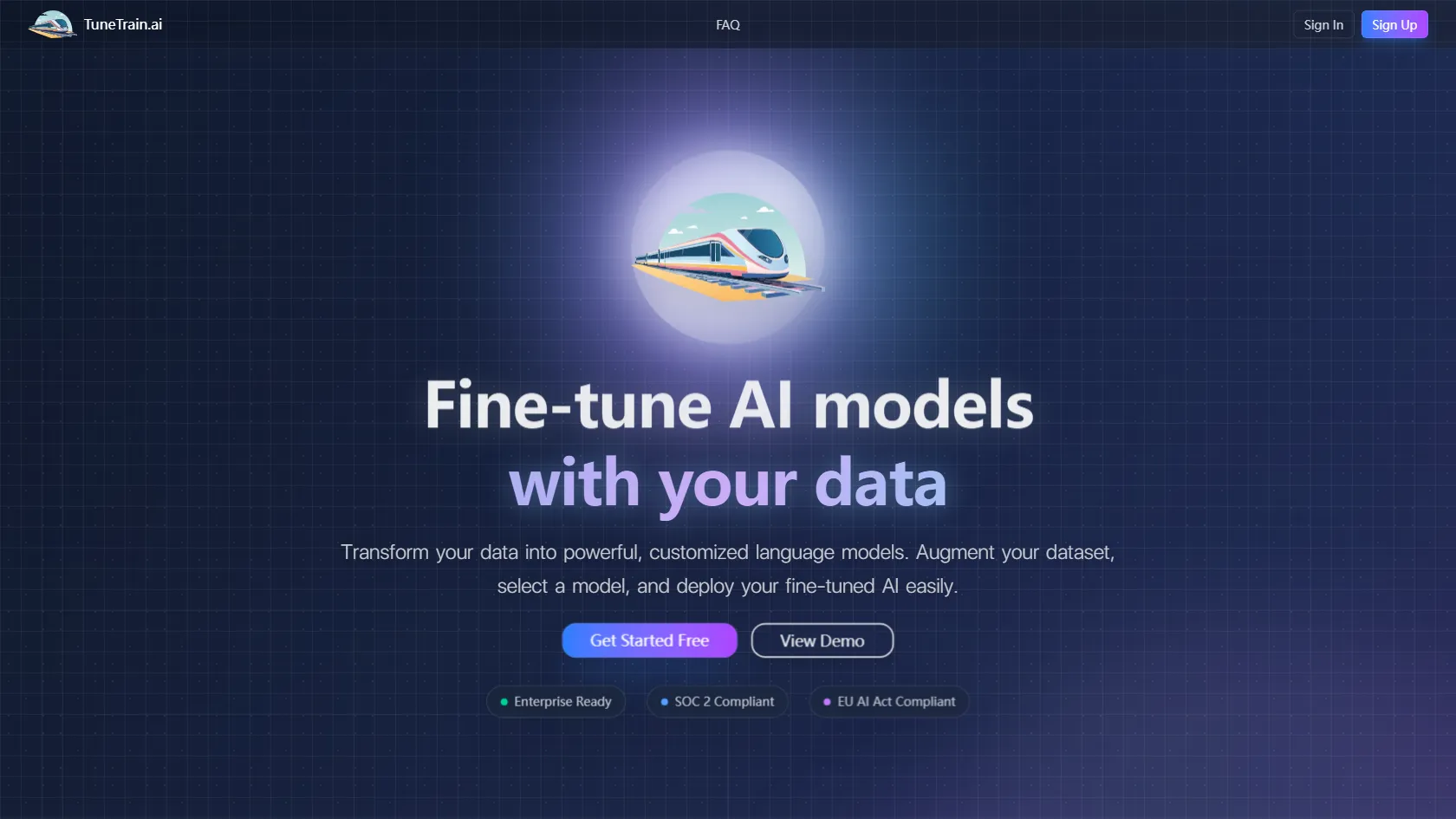
TuneTrain.ai is a comprehensive platform that simplifies fine-tuning of small language models using your own data. It enables dataset management, augmentation, and model training without requiring machine learning expertise. The platform supports popular models like Llama 3, Mistral, and Phi-4, providing enterprise-grade security and compliance while making AI customization accessible to businesses of all sizes.
Freemium
How to use TuneTrain.ai?
Upload your datasets in CSV or JSONL formats, use built-in tools for data augmentation and LLM-based distillation, select from supported models like Llama 3 or Mistral, and initiate fine-tuning. The platform handles the complex training process, allowing you to monitor progress in real-time and download customized models for deployment. This solves problems of limited training data, high computational costs, and technical barriers to AI model customization.
TuneTrain.ai 's Core Features
Dataset Management: Upload, organize, and manage datasets in CSV and JSONL formats with version tracking and quality maintenance
Dataset Augmentation: Generate synthetic data variations automatically to expand datasets and improve model performance and diversity
LLM-based Distillation: Leverage large language models to distill knowledge into smaller, efficient models while maintaining quality
Instruction Fine-tuning: Fine-tune models with instruction-following capabilities for specific task execution and understanding
Model Selection: Access curated selection of state-of-the-art small language models optimized for efficiency and performance
Real-time Monitoring: Track training progress and performance metrics throughout the fine-tuning process
Enterprise Security: SOC 2 and EU AI Act compliant with encrypted data processing and strict privacy protection
TuneTrain.ai 's Use Cases
Startups can fine-tune customer service chatbots using their specific support data, improving response accuracy and reducing human agent workload
Researchers can create specialized AI models for academic analysis by training on domain-specific research papers and datasets
Content creators can develop personalized writing assistants trained on their unique style and content preferences
E-commerce businesses can build product recommendation engines fine-tuned on their customer behavior and purchase history data
Healthcare organizations can create medical documentation assistants trained on proprietary patient data while maintaining compliance
Educational institutions can develop tutoring systems customized to their curriculum and teaching methodologies